Tuesday, November 15, 2016

Changem, Be The: Vote Essay | Peer Edit, Revise, Reflect

Standards:
  • CCSS.ELA-LITERACY.CCRA.W.5 Develop and strengthen writing as needed by planning, revising, editing, rewriting, or trying a new approach. 
  • AP Human Geography IV. Political Organizations of Space, B. Spatial political patterns reflect ideas of territoriality and political power at a variety of scales)
Objective:
  • Jedis will be able to edit and revise their own "Change, be the: Vote" essay. 
  • Jedis will be able to support one another in the writing process by editing and revising their peer's essays.
1. Prepare your desk
  • Get out "Change be the, Vote" Essay
  • Turn in Week 14 Reading Log
  • Write down tonight's homework in planner.
    • 45 min reading/summary
    • Final Draft of "Change be the, Vote" Essay (Due Monday 11/21)
  • Stamps
2. A few examples to remind us why editing and revising matters...
3. What is the difference between Editing and Revising? CUPS vs ARMS.

4. Self Edit and Revision

6. Peer Edit and Revision Cycle

7. If we finish with extra time, you may being rewriting your essay.

Sunday, November 6, 2016

Clinton vs. Trump Issues

Clinton vs. Trump Issues: https://www.washingtonpost.com/graphics/politics/political-issues/

Monday, October 24, 2016

Jedi Ms. Kelly's Trial 3 Notes (Day 133-131)

  1. Sub will introduce themselves and explain the agenda for the day, and pass out new reading logs 
    • I accidentally took the stamps home with me, so no stamps. 
    • I will collect logs when I see you next.
    • Own your education: Chitchatting is not an option. 
  2. Ask students to write their homework in their personal planner. 
  3. Practice North America on your personal map whiteboards (in your binders)
    • If you feel confident about the text, you may choose to work on your Book Review, as well.
  4. Sub will distribute the practice test. You will have about 15 min. Do not write on my test. Number their own sheet of paper 1-54.
  5. Exchange papers and grade using the answer keys provided. 
    • Yes, 15 minutes is enough time if you have studied. 
    • Yes, spelling counts. 
    • Yes, you need to spell out Washington, District of Columbia. 
    • No, I am not putting this in the grade book. I just want you to see how prepared you are for Trial 3 which will be on Thurs/Fri.
    • I accept nothing less than a 3 on an exam.
  6. Put your own corrected Practice Test in the Unit Archived section of your binders. If you did not score a 3 or better on the practice test, you will need to make sure you allot extra time to study for both the geography portion and the Middle East vocab/content section.  

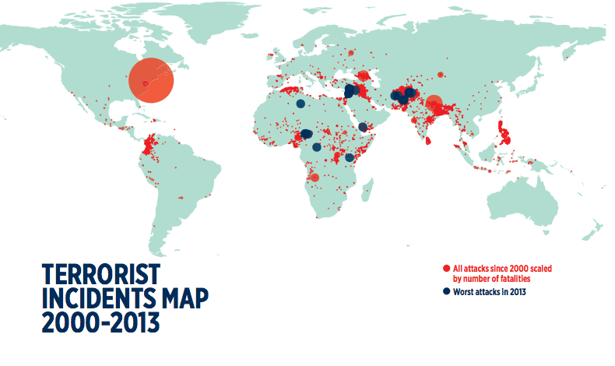
*This map is just for the curious.

Thursday, October 13, 2016

Globalization & the Events that Lead to 9/11 (Day 14-139-- Period 1, 3, 4, and 5)

Image result for negative effects of globalization comic


Standards
:

CCSS.ELA-LITERACY.RH.9-10.1 Cite specific textual evidence to support analysis of primary and secondary sources, attending to such features as the date and origin of the information. AP HUMAN GEOGRAPHY III. Cultural Patterns and Processes: The Forces of Globalization challenge contemporary political territorial arrangements.

Objective:

Students will be able to cite evidence of the role globalization played in 9/11.


Image result for mcworld vs jihad
1. DO NOW:
  • Books/Planner/Notebook out on desk.
  • Write Homework in Planner
  • Turn in tab open to Reading Log
  • DO NOW: Take a look at the following image. What symbols can you find embedded in this image? What do you think this image is trying to convey? Who is the image directed at? Is it positive or negative? 
    • If you finish early, you may choose to own your education by doing one of the following:
      • Practice vocabulary
      • Practice geography on your whiteboards
      • Check out a new book on my laptop
      • Read your book
        • Talking is not an option.
2. Turn and Talk
3. Whole Group Share: 3 students using random #s.
4. Globalization and the Events that lead to 9/11-- annotate, analyze, cite evidence.
  • Whole Group
  • Then, you may choose to work independently or with a partner.
    • Raffle tickets to students who find opportunities to challenge the images, text, or question me analytically!
5. Exit Slip: What role did globalization play in 9/11? Cite evidence from your text. Does this change how you view the image from our DO NOW? Explain.

Homework

  • Read, Jedi! Read!
  • Complete Globalization and the Events that lead to 9/11 Packet


Tuesday, October 11, 2016

Grading Trial 2B & Getting Organized (Day 142-141)

Checking:

  • Reading Log
  • Planner
Turn in:
  • Book Review (-1 day late)

1. Grade Trial 2B
2. Discussion
  • How did we do? Why?
  • How can we improve?
2. Organize Binders:
  • Preparing and studying for exams requires organization.
  • If we can't find our assignments, notes, and directions for projects... how can we complete things at a college-ready level?
Homework:
  1. Read Jedi, Read!
  2. Book Review (if you have not yet submitted)--> Tomorrow is the last day to turn in for a 2 (C) at the highest.

Wednesday, October 5, 2016

Retake Trial 2 (Day 145-143)

1. Retake Trial 2

Homework:

  • Read Jedi, Read!
  • Book Review (Sept/Book 1)--> Due Monday
    • Directions for Book Review:
      • Length: 
        • If handwriting: skip a line between line, and write two full pages front and back, or four pages front only, stapled with your heading on every front page
        • If typing: two pages printed and stapled together, double-spaced, times new roman font at 12 pt size. Heading on every front page.
        • Below is a Template and an example. You can also check out newspapers to see samples of book reviews. 
BOOK REVIEW TEMPLATE

HEADLINE:  Include the title of the book (try to use a pun!)-- note: book titles are typed in italics. 

PARAGRAPH #1:  Introduce the book by creatively stating that you’ve just read this book and would like to give an opinion about it.  Mention a couple of details that might help the reader understand what type of book you are talking about. Invest your reader in your review.

PARAGRAPH #2:  Summarize the plot (story).  Where and when did it take place?  Who are the main characters?  What is the story about?  Remember, do NOT include spoilers and do not tell how the story ends! 

PARAGRAPH #3:  Talk about the characters and discuss who the author did a good job putting onto paper and what characters needed more of in order for you to consider it a stronger book. 

PARAGRAPH #4:  Talk about what you liked about the book and what you didn’t like.  Be sure to include a few specific details and scenes—but NO SPOILERS.

PARAGRAPH #5:  What lessons did you learn from this story (theme/moral)?  What do you think others will learn from it? What do you think the author wanted to you learn? Is there an underlying message?

PARAGRAPH #6:  What group of people would like this movie?  Who would you recommend it to?  Who would you not recommend it to? What is your final word on the book:  Is it a must read or a snore-fest?

RATING SYSTEM:  Give the Book a score.  You can do grades (A,B,C, NP), stars (*** out of ****), numbers (3 out of 4) or something totally original…  just don’t use “thumbs up” or “thumbs down.”

SHORT BIOGRAPHY:  Explain who you are, what your school level is (freshman, junior, etc.), your job (if you have one), sports you play and interesting things you like to do.  Talk about yourself in the “3rd person,” that is; pretend someone else is writing the bio about you. 
  BOOK REVIEW EXAMPLE

TITLE:  “My Dog Skip” will have you skipping to the Library

By Coop Cooper, A.K.A. “The Small Town Critic”

Everyone remembers their childhood dogs and the impact they’ve had on their life.  Perhaps one dog in particular sticks out in your mind… a special dog that was there for you in the toughest or best years of your life.  That is what the book, Willie Morris’ “My Dog Skip” conveys. This book is fun, yet nostalgic and heartbreaking.  Morris recounts the autobiographical memoir of his childhood in Yazoo City, Mississippi and the four-legged friend that accompanied him on his journey into manhood. 

Set in the backdrop of the war-torn world of the 1940’s, young Willie is on the verge of his ninth birthday.  His only real friend, neighbor and high school sports hero Dink Jenkins goes off and fight in WWII, leaving Willie feeling alone in the world.  To lift Willie’s spirits, his mother decides to defy the wishes of his stern father and buy Willie a Jack Russell terrier puppy.  The unusually smart and charismatic dog Skip quickly becomes a local institution and helps Willie gain respect, make friends and even win over his first girlfriend. 

Since this book is a memoir, the young Morris is depicted through the author’s own eyes, looking back at himself. Morris, the author is able to convey Morris, the boy in his book, as mature, with shades of emotions that effectively keep the reader invested in the book.  His parents are portrayed as caring and concerned parents, with the character of Dink Wilson bringing in the comedic relief as he pulls off the disgraced town hero with surprising effectiveness.   However it’s the dog that steals the show. Skip will keep you hooked page after page.

Morris’ parents were strong characters in the book, but didn’t get enough time to fully develop.  In addition, Willie’s friendship with a young black boy was never given a chance to develop either, probably in an effort by the editors to avoid focusing on the segregation issues of the time period.  The issue is addressed, but I feel that the African-American characters should have had bigger, more substantial parts.  Also, I didn’t get the whole subplot with the evil moonshine dealers and why they tormented little Willie and Skip.  I had to keep reminding myself that this was a memoir because these areas seemed like a fictional part slapped on to cause more conflict.  Despite these objections, the book seemed to genuinely convey the feeling of growing up in rural Mississippi.  The attention to detail and the accuracy of the time period were phenomenal and thought provoking.  I felt completely immersed in this world and felt the full effect of this moving story.  Even the southern accents were written into the dialogue such that I could easily hear them speak in my own mind.

The message of this book is very clear and invokes plenty of nostalgia to anyone who can identify growing up in a rural town.  It’s about passing into adulthood, remembering old friends long gone, and the desire to remember or relive happy moments in our lives that may be fading from our memory.  Morris is certainly a master at preserving his own memories by writing it down for others to enjoy.  I truly believe that this story is his gift, not only to the people of Mississippi, but to all who want to remember their past, and the friends they left behind.  

This book is truly for everyone.  Most books geared for children these days depend on lame, pop-culture references and gas-passing jokes in a patronizing attempt to entertain the younger masses.  This book rises above all of that to become one of the most readable non-Disney-esque books as of late.  Your friends might resist the urge to read a book named after a dog, but try to talk them into it.  They won’t regret it and neither will you. 

Scale of 1-5:
4 ½ 

Coop Cooper is an independently syndicated book critic, living in Los Angeles. He is originally from Clarksdale, Mississippi and a Southerner at heart. He graduated from Brown University with a B.F.A in Literature, and received his Masters in Journalism from UCLA.  You can read his past reviews at http://www.thesmalltowncritic.com/. 

If you have questions. Text Jedi Ms. Kelly. Her number is in your syllabus.

Thursday, September 29, 2016

Close the Gap. Lead by Example (Day 148-146)

Image result for lead by example1. Do Now:

  • Binder Out-- open to reading log
  • Agenda Out- write down homework
  • Book Out
2. Separate into two groups
-Have NOT finished Trial 2 retake form: 
  • Stay in the class and work.

-HAVE finished Trial 2 retake form: 
  • Break into study group and compare answers. Then, you may watch the following documentary:
    • Inside 9/11: Zero Hour
      • Three things to keep in mind about this video:
        • This documentary has live footage of the events, some of it graphic and shocking.
        • This documentary includes personal interviews and survivor accounts which piece together anecdotal evidence of the events.
        • This documentary was written by Americans, for Americans. It is biased and sometimes stereotypes/generalizes Muslims and Middle Eastern people. It is also a fantastic window into the post-9/11 opinions/reactions of the American people.
        • This is video 1 of 4.

Homework:
  • Read Jedi, Read!
  • North America Map
  • Complete Trial 2 Retake Form--> Due Monday. If it is incomplete, you will receive an Academic detention aka Guardians of the F.O.R.C.E.
  • Above and Beyond: Watch Inside 9/11: Zero Hour


Wednesday, September 28, 2016

Globalization and the Events that lead to 9/11 (Day 149- Period 2 only)

Image result for negative effects of globalization comic


Standards
:

CCSS.ELA-LITERACY.RH.9-10.1 Cite specific textual evidence to support analysis of primary and secondary sources, attending to such features as the date and origin of the information. AP HUMAN GEOGRAPHY III. Cultural Patterns and Processes: The Forces of Globalization challenge contemporary political territorial arrangements.

Objective:

Students will be able to cite evidence of the role globalization played in 9/11.


Image result for mcworld vs jihad
1. DO NOW:
  • Books/Planner/Notebook out on desk.
  • Write Homework in Planner
  • Turn in tab open to Reading Log
  • DO NOW: Take a look at the following image. What symbols can you find embedded in this image? What do you think this image is trying to convey? Who is the image directed at? Is it positive or negative? 
    • If you finish early, you may choose to own your education by doing one of the following:
      • Practice vocabulary
      • Practice geography on your whiteboards
      • Check out a new book on my laptop
      • Read your book
        • Talking is not an option.
2. Turn and Talk
3. Whole Group Share: 3 students using random #s.
4. Globalization and the Events that lead to 9/11-- annotate, analyze, cite evidence.
  • Whole Group
  • Then, you may choose to work independently or with a partner.
    • Raffle tickets to students who find opportunities to challenge the images, text, or question me analytically!
5. Exit Slip: What role did globalization play in 9/11? Cite evidence from your text. Does this change how you view the image from our DO NOW? Explain.

Homework

  • Read, Jedi! Read!
  • Complete Globalization and the Events that lead to 9/11 Packet


Tuesday, September 27, 2016

Trial 2 Retake Form (Day 150-149) P1 and 3-5

Do Now:

  • Get out reading log
  • Write down homework in planner.

1. Go over Trial Retake Form.
2. Class vote: 9/11 documentary vs Trial Retakes

Homework:
  • Read, Jedi. Read!
  • Finish Trial Retake Form. Due next period.

Monday, September 26, 2016

1-on-1 Check in (Day 151)

Do Now:
-Reading logs
-Write homework in Planner
-Stamps

1. Finish scoring Trial 2
2. Reading Log Check in
3. Grades Check in

Homework:

  • Read Jedi, Read!
  • Study for Trial 2 retake!


Thursday, September 22, 2016

Grade Trial 2 (Day 153-152 )

Do Now:

  • Books out
  • Flashcards out
  • 9/11 Report Annotations and Cornell notes Out
  • Reading Log Stamps
  • Write down homework in Planner
  • Planner Check (or 10$)

1. 30 min to work on Flashcards or the anotations/cornell notes for The 9/11 Commision Report: Executive Summary

2. Grade Trial 2 (P1 & P2)

Homework:

1. Read, Jedi, Read!
2. Study for Trial 2 Retake
3. Unit 2 Vocab 13-18-- include examples and pictures that you can associate with the word. See example-->


  • 13. Islam: A religion based on the teachings of the prophet Mohammed which stresses belief in one god (Allah), Paradise and Hell, and a body of law written in the Quran. Followers are called Muslims.
  • 14. sect: A religious group that has distinctive teachings & doctrines; belong to a larger group. For example,  Within Islam, there are two main sects, Sunni and Shiite.
  • 15. Sharia Law: Islamic laws taken from the Qu'ran (the holy Book of Islam); often interpreted differently by different groups.
  • 16.  Shiite/Shia: (Minority) A branch of Islam whose members believe that "descendants of Ali should be true rulers of Islam." This group is the minority, but are the majority in Iran and areas of Iraq
  • 17. Sunni: (Majority) A branch of Islam whose members believe that because Muhammad did not appoint a leader to follow him, Muslims should be led by an elected/appointed religious leader who demonstrates that he is a knowledgeable and pious muslim.
  • 18.  Caliphate: An Islamic state led by a supreme religious and political leader


Intro to 911 (Day 155-154)

Do Now:

  • Books out
  • Flashcards out
  • Reading Log Stamps
  • Write down homework in Planner
  • Planner Check or 10$

1. 30 min more for Trial 2

2. Get out a piece of paper

  • Title: Do Now | Unit 2 Introduction
  • Write one paragraph explaining what you think the phrase "One man's terrorist, is another man's freedom fighter" means?

3. Read and Annotate 9/11 Commision Report: Executive Summary

4. Cornell Notes for the 9/11 Commision Report: Executive Summary

Homework:

1. Read, Jedi, Read!
2. Finish annotations/cornell notes for  9/11 Commision Report: Executive Summary
3. Unit 2 Vocab

  • 7. Post 9/11 U.S. Domestic Policy- US PATRIOT ACT:  Congressional approval of the US PATRIOT ACT gave FBI the power to tap phones, track internet usage, and secretly search a "suspect's" home or office.
  • 8. US PATRIOT Act Controversy: 
    • invasion of privacy
    • unconstitutional, took away rights
    • could be used to pursue people outside of terrorism
    • criteria for becoming a suspect was loose and open to interpretation
  • 9. Post 9/11 U.S. Domestic Policy- HOMELAND SECURITY: U.S. government department created by the Bush administration after the attacks of September 11, 2001, to prevent terrorist attacks within the United States and reduce the country's vulnerability to terrorism.
  • 10. Post 9/11 Foreign Policy -WAR ON TERROR: 
    • Shifted response to terrorism from a criminal act to a war crime.
    • Created the department of Homeland Security to take lead on all things related to US public security
    • Congress gave Bush permission to use force on whoever did it
    • Resulted in the military pursuit of Al-Qaeda cells all over the world, with/without permission of countries they were operating in
  • 11. Post 9/11 Foreign Policy- BUSH DOCTRINE: The U.S. foreign policy adopted by the Bush administration in 2001 that asserts America's right to attack any nation that has weapons of mass destruction that we believe might be used against U.S. at home or abroad.
  • 12. Guantanamo Bay Detention Center: A U.S. prison camp located in Cuba to "detain extraordinarily dangerous people", interrogate and prosecute detainees (both civilian and military) for war crimes. It has been called unjust because the military acts as interrogators, prosecutor, defense counsel, judge, and executioners. It does not follow US law, but it is not on U.S. soil--- so it does not have to. Violates a number of human rights laws.

Monday, September 19, 2016

Level UP: Trial 2 (Day 156)

1. Do Now:
  • Get out book/Turn in Week 6 Reading Logs
  • Write homework in Planner (copy vocab if you do not have internet at home)
  • Stamps
2. Finish Trial 2

Homework:

1. Read, Jedi, Read!
2. Unit 2 Vocab
  1. Sovereignty: The right of a country to govern its territory free from control of its internal affairs by other countries. 
  2. Imperialism: A policy of extending a country's power and influence through diplomacy or military force.
  3. Transnational: transnational operating in at least two countries.
  4. Islam: A religion based on the teachings of the prophet Mohammed which stresses belief in one god (Allah), Paradise and Hell, and a body of law written in the Quran. Followers are called Muslims.
  5. Extremist Islam: Extremist beliefs that the Quran is the ultimate decider over political and social life. Uses violence in the name of Jihad and create rifts between Muslim and between countries. 
  6. 9/11: Terrorist attack on United States by Al-Qaeda, led by Osama bin Laden. The terrorist group hijacked 4 passenger planes and crashed them into:
    • 1. World Trade Center tower; 
    • 2. World Trade Center tower; 
    • 3. Pentagon 
    • 4. Likely attempted the White House, but the plane was brought down by passengers in a Pennsylvania field

Thursday, September 8, 2016

Types of Maps & Time Zones (163-162)

1. Set up binder
  • Organize binder for binder checks next week.
2. Go over answers to Middle East Map (p2/4 only)
3. Whole group Lessons 6-14 in Basic Geography Skills Packet (2)

Homework:
1. Read Jedi, Read.
2. Prepare for Trial 2 on Sept 15-16


  1. Study Middle East using whiteboards and Sheppard Geography: 
  2. Syria 
  3. Cyprus 
  4. Israel & the Palestinian Territories 
  5. Jordan 
  6. Egypt 
  7. Saudi Arabia 
  8. Yemen 
  9. Oman 
  10. United Arab Emirates 
  11. Qatar 
  12. Bahrain 
  13. Kuwait 
  14. Iraq 
  15. Iran 
  16. Turkmenistan 
  17. Kazakhstan 
  18. Uzbekistan 
  19. Kyrgyzstan 
  20. Tajikistan 
  21. Afghanistan 
  22. Pakistan 
  23. Lebanon 
  • Study Vocabulary using flashcards or Quizlet
    • Practice: 
      • Identifying Relative vs Absolute Location 
      • Identifying Cardinal locations 
      • Identifying Intermediate locations 
      • Using Scale bars 
      • Using Latitude and Longitude

Tuesday, September 6, 2016

Longitude and Latitude (165-164)

1. Set up binder

  • Turn in Week 4 Reading Logs
2. Go over answers to Middle East Map
3. Go over answers to Lessons 2-6 in Basic Geography Skills Packet

Homework:
1. Read Jedi, Read.
2. Prepare for Trial 2 on Sept 15-16
  1. Syria
  2. Cyprus
  3. Israel & the Palestinian Territories
  4. Jordan
  5. Egypt
  6. Saudi Arabia
  7. Yemen
  8. Oman
  9. United Arab Emirates
  10. Qatar
  11. Bahrain
  12. Kuwait
  13. Iraq
  14. Iran
  15. Turkmenistan
  16. Kazakhstan
  17. Uzbekistan
  18. Kyrgyzstan
  19. Tajikistan
  20. Afghanistan
  21. Pakistan
  22. Lebanon

Thursday, September 1, 2016

Substitute (167-166)

Ms. Kelly is out sick Thursday 9/1-Friday 9/2.
The substitute will provide handouts for classwork and homework.

Tuesday, August 30, 2016

Absolute vs. Relative Location (169-168)

1. Set up binder

  • Write Down homework
  • Reading Log Check
2. Get out Geography Packet from time with Substitute
3. Whole Group: Lesson 1
  • Annotate
  • Complete Questions

Homework:
  • Read Jedi, Read!
  • Bring Book in Reading Range starting 9/6
  • Geography Packet: Lesson 2-6 (due 9/6)
  • Middle East Map (due 9/6)

Monday, August 29, 2016

Manual Lexile Leveling (170)


    \
  1. Set up for class (5 min)
    • Pick up Laptop
    • Open Binder to turn in
    • Write down homework in planner
  2. When finished, Google Survey Quiz on Sub Material (15 min.)
    • Planner Check
    • Homework Check
  3. Together, we will watch this Video on how to Manually Lexile Level ANY book (p1)
  4. Exit Slip (10 min.)
  5. Closing (5)
Homework:
  • Read, Jedi Read!
  • Finish Lexile the Leveling Worksheet.

Wednesday, August 24, 2016

Substitute (172-171)

Ms. Kelly is out sick Wednesday 8/24-Friday 8/26.
The substitute will provide handouts for classwork and homework.

Tuesday, August 23, 2016

Lexile and Diagnostic Reflections (174-173)

1. Do Now:
  1. Get a laptop
  2. Set up desk
    • Binder open to Reading Log
    • Planner open to this week
    • 12 complete Flashcards
  3. Write down homework

3. Diagnostic Reflection

4. Manual Lexile Leveling

5. Lexile Scavenger Hunt

Homework:
1. Read, Jedi Read --> 45/Summary/Signed
2. Get a book on your reading level
3. Flashcards (see below)
4. Get Jedi Reflection Signed
5. Complete Lexile Scavenger Hunt and get signed
6. Study for Middle East (Trial 2)

13. Eratosthenes: He invented the word "geography" and calculated the Earth's circumference
14. Aristotle: First demonstrated that the earth was round by gravity theory, earth's circular shadow and proving that stars travel N or S together.
15. Mercator projection (1569): Type of map that uses right angles; direction is perfect; distorts size as you get closer to poles; characterized by a very large Greenland or Antarctica
16. Robinson projection (round edges): type of map that tries to correct distortion near polls by curving; distortion is moderate as you move away from poles; shapes are true around 45° N or S or within 45° of the Central Meridian; balances distortion by making errors in all four ways
17. Peters projection (1974): type of map that focuses on keeping landmasses true; corrects misconceptions about the size of Africa and Latin America created by the Mercator and Robinson maps; controversial
18. Equal area projections: type of map where relative sizes are the same; distorts shape near poles; to preserve size and shape of land masses; interruptions and meridians that do not converge or form right angles with the parallels

Monday, August 22, 2016

Lexile Bookmark (175)

1. Do Now:
  1. Get a laptop
  2. Set up desk
  3. Write down homework
  4. Complete New Reading log
2. Get out 1 Index Card and Log into Achieve
  • Lexile Level
3. Lexile.com
  • Lexile Range

Homework
1. Read, Jedi Read --> 45/Summary/Signed
2. Get a book on your reading level
3. Flashcards
4. Study for Middle East (Trial 2)

7. Scale: Generally, the relationship between the portion of the Earth being studied and the Earth as a whole, specifically the relationship between the size of an object on a map and the size of the actual feature on Earth's surface
8. Space: The physical gap or interval between two object
9. Site: Physical characteristics of a place; ex: climate, water sources, topography, soil, vegetation, latitude, and elevation
10. Region: An area distinguished by a unique combination of trends or features
11. Culture: The body of customary beliefs, social forms, and material traits that together constitute a group of people's distinct tradition
12. Resource: A substance in the environment that is useful to people, is economically and technologically feasible to access, and is socially acceptable to use

Thursday, August 18, 2016

Jedi Trial 1 (177 & 176)

1. Set up your desk.
2. Write homework in planner.
3. Get out two sheets of paper:

  • Fold them vertically (hotdog) down the middle. 
  • Number 1-235. Do not skip lines. 
  • Use both columns on each side of the paper

4. Tutorial Expectations for SSS/Tutoring

  • Tutorial Log
  • Learning Process
  • Tutorial Request Form

5. EOY Final -- only Trial 1 will go in the gradebook!
  • Finish Early? Assign yourself to one of these things:
    • Read a book and record your time on your log-- I'll sign for the minutes you read.
    • Do homework from another class
6. Jedis hand-grade each other's Trial 1.
7. Analyze the results of our diagnostics using this Google Form.

Homework:


  • Read, Jedi! Read! (45/Summary/Signed)
  • Flashcards for the following Unit 1: Basic Geography Concept Vocabulary
    1. Globalization: Actions or processes that involve the entire world and result in making something worldwide in scope
    2. Geography: The study of where things are found on Earth's surface and the reason for the location
    3. Human geography: The study of where and why human activities are located where they are; ex: religions, businesses, and cities
    4. Physical geography:  The study of where and why natural forces occur as they do; ex: climates, landforms, and types of vegetation
    5. Map: A two-dimensional, or flat, representation of Earth's surface or a portion of it
    6. Cartography: The science of making maps
  • Begin studying for Trial 2 Geography section: Middle East Region
    1. Syria
    2. Cyprus
    3. Israel & the Palestinian Territories
    4. Jordan
    5. Egypt
    6. Saudi Arabia
    7. Yemen
    8. Oman
    9. United Arab Emirates
    10. Qatar
    11. Bahrain
    12. Kuwait
    13. Iraq
    14. Iran
    15. Turkmenistan
    16. Kazakhstan
    17. Uzbekistan
    18. Kyrgyzstan
    19. Tajikistan
    20. Afghanistan
    21. Pakistan
    22. Lebanon

Tuesday, August 16, 2016

Diagnostic (179 & 178)

1. Set up your desk.
2. Write homework in planner.
3. Take Diagnostic
4. Grade with GradeCam
5. Assign yourself to one of these things:

  • Complete your unfinished notes on "Why Reading Matters"
  • Borrow my binder and ensure your binder is ready for binder check
  • Practice identifying and spelling areas on a whiteboard for Trial 1
  • Read a book and record your time on your log-- I'll sign for the minutes you read.
  • Do homework from another class
Homework:
  • Read, Jedi! Read! (45/Summary/Signed)
  • Study for Trial 1

Monday, August 15, 2016

Prepare for Trial 1 (180)

1. Pick up today's Handouts and whiteboards.
2. Prepare your desk for class, using the diagram on the right (no laptops/no notes)
3. Write down homework in agenda.
4. Practice on whiteboard.
5. Homework Check:

  • Map (labeled and colored)
  • Reading Log
  • Agenda
  • Letter/Syllabus Receipt if you have not yet turned it in

6. If time (or at home), Practice for Trial 1.

Homework:
1. 42/summary/signed
2. Study for Trial 1
3. If your map had mistakes or was incomplete, you have 24 hours to fix it and show it to me. DO NOT leave it on my desk. Come find me.

Thursday, August 11, 2016

The Jedi Binder (Day 182 & 181)


1. Setting up the Jedi Binder
2. Assignment 3
Homework:
  1. Get all materials and prepare binder for check.
  2. 42/Summary/Signature
  3. Study for Trial 1
    • Per 1, 3, 5: Thursday Aug 18
    • Per 2, 4: Friday Aug 19
  4. Color ONE SIDE of your map, and identify the following areas:
    • North America
    • Central America
    • South America
    • Greenland
    • Europe
    • Asia
    • Africa
    • Middle East
    • Australia
    • New Zealand 
    • Antarctica
    • Pacific Ocean 
    • Atlantic Ocean 
    • Indian Ocean 
    • Arctic Ocean 
    • Southern Ocean

Additional Homework for Periods 2 and 4:

Period 2:
Period 4:
  • All of the above AND
    • Complete Cornell Notes for Why Reading Matters
    • Letter to Jedi Ms. Kelly
      • Previous Educational Experience/Who you were as a student
      • What kind of student do you want to be moving forward? What will you do to accomplish your goals? How can I help you achieve these goals?

Tuesday, August 9, 2016

The Ways of the F.O.R.C.E. (Day 184-183)

  1. Setting up your Cornell Notes
  2. Intro to the Jedi Code: A Metaphorical Guide to Life


  3. The Ways of the F.O.R.C.E. Presentation
  4. Summarize Notes & Share out
  5. Practice Continents and Oceans on Whiteboards
    • Identify and correctly spell the following: 
      1. North America
      2. Central America
      3. South America
      4. Greenland
      5. Europe
      6. Asia
      7. Africa
      8. Middle East
      9. Australia
      10. New Zealand 
      11. Pacific Ocean 
      12. Atlantic Ocean 
      13. Indian Ocean 
      14. Arctic Ocean 
      15. Southern Ocean
  6. Homework and Supplies Check
  7. Exit Slip: Letter to Jedi Ms. Kelly

All Classes Homework:

  • Daily Reading-- 42 minutes, summary, parent signature. If you missed a day or did not read the full 42 minutes, you must add additional minutes to catch up for the lost time.
  • Study for Trial 1: Continents and Oceans on Aug 18-19

Additional Homework for Period 2 and 4:

  • Letter to Jedi Ms. Kelly
    • Previous Educational Experience/Who you were as a student
    • What kind of student do you want to be moving forward? What will you do to accomplish your goals? How can I help you achieve these goals?

Monday, August 8, 2016

Welcome to Human Geography (Day 185)


  1. Welcome
  2. Meet Jedi Ms. Kelly
  3. Go over Syllabus & Materials
  4. Pass out Syllabus Receipt & Wordsearch
  5. Jedi Name Game (If time)
Homework:

  1. Go over Syllabus with parent and both sign Syllabus Receipt
  2. Complete Wordsearch
  3. Read any book you want for 42 min and complete/parent sign Jedi Reading Response Log
  4.  Gather the following supplies:
  • Spiral bound Student Planner
  • Headphones/Earbuds
  • 3-Ring Binder (HG only)
  • Dividers w/ Labels
  • Notebook paper

  • Post-it Notes
  • Index Cards 
  • Colored Pencils 
  • Highlighters 
  • Pencils (with extra lead if you are using mechanical)